“Statistics are like a bikini. What they reveal is suggestive, but what they conceal is vital.” economist Aaron Levinstein
I thought of that quote when I saw this graph recently on LinkedIn, highlighting the growth of Chief Partnerships Officers.
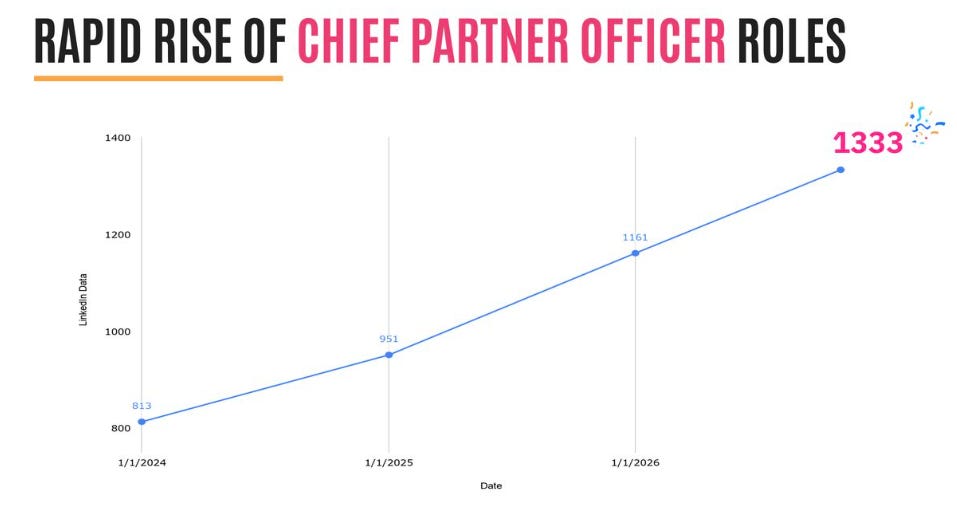
The graph is meant to suggest that partnerships are thriving. But it conceals so much.
A job title tells you about org charts, not impact.
Job titles are not a meaningful metric because they vary so widely from company to company. That’s why we don’t evaluate the power of marketing based on the number of CMOs. Also, counting the number of Chief Partnerships Officers is biased towards large companies, since smaller companies tend to avoid chief titles.
I saw this graph and asked a different question: what metrics show the value of partnerships across an entire industry? With help from my favorite AI chatbots and MCP connectors, I analyzed millions of job postings, 1,368 earnings calls and 15 years of SEC filings.
Here is where I dug for data and what Idiscovered …
Demand for Partnership Jobs
Job postings are a direct signal of demand for partnerships.
I searched Coresignal, a job listings database, for LinkedIn job postings with “partnerships” in the title from August 2020 (where its data begins) through October 2026, and compared them with postings that have “sales” in the title.
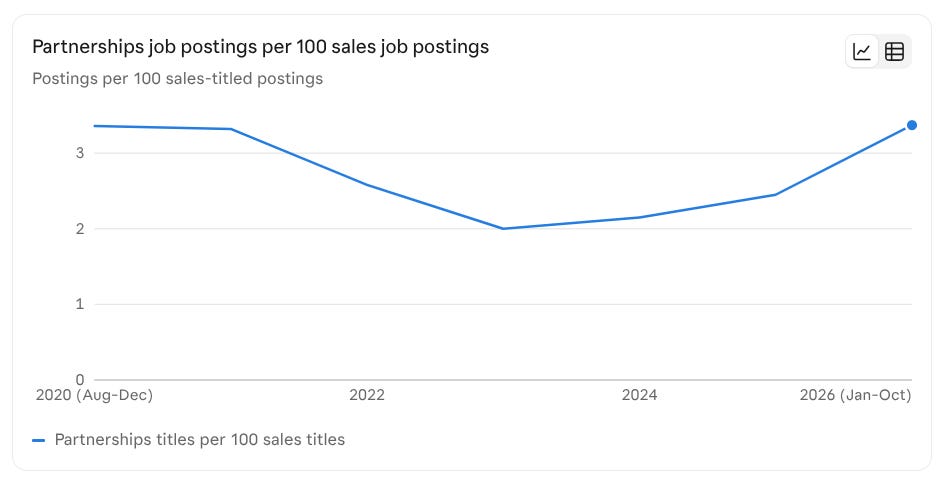
Findings:
About 3 partnerships roles are posted for every 100 sales roles. That likely undercounts reality. Adding jobs with “alliances” titles raises it to about 4 per 100 in 2026. And keep in mind, that is all sales roles (e.g. sales ops, sales enablement).
Partnerships hiring is relatively flat. Demand for partnerships has remained relatively consistent since 2020. There was a dip in 2022 and 2023 but the rate has returned. Six years is not a long time period for hiring trends but it’s the best data I’m able to access.
Earnings calls
Quarterly earnings calls are led by the C-suite and reflect what a company wants investors to hear. I analyzed 1,368 earnings calls from 51 tech companies, from BigTech to mid-cap SaaS to global systems integrators, from 2020 through mid-2026. I counted a basket of nine partnership terms, including “partner ecosystem,” “channel partners,” “co-sell” and “partner-sourced.”
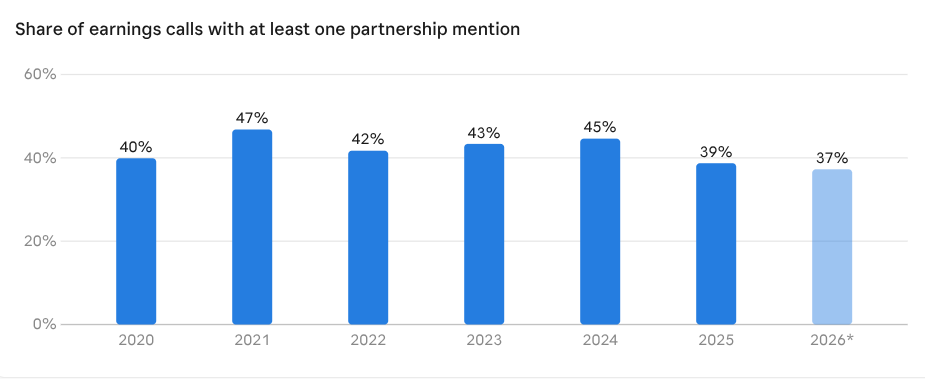
Findings:
A material portion of earnings calls consistently mention partnerships: 40% - 45% of earnings calls include mention of partnerships.
Partnership mentions during earnings calls has been fairly consistent over the last 6 years.
The most common terms are “partner ecosystem” and “channel partners” - there are not many mentions of more specific terms like“partner-sourced” or “partner attach.”
SEC Filings
10-K Reports
Public companies must file a 10-K with the SEC every year, summarizing their financial health and risks for investors. Unlike an earnings call, a 10-K is a legal document, so what goes into this document is chosen carefully.
I picked the two partner terms most commonly used in earnings calls (“partner ecosystem” and “channel partners”) and I queried the SEC’s public database to see how often these terms are used in 10-Ks going back to 2011.
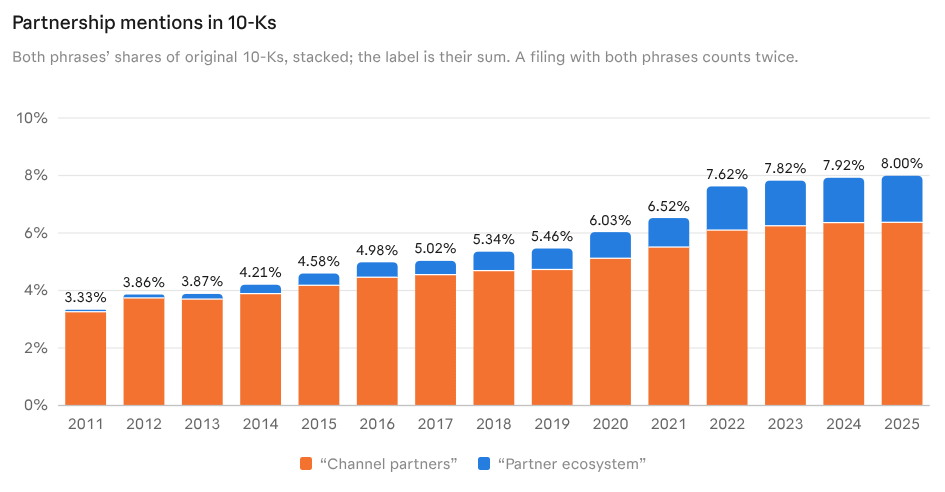
Findings:
Partnership mentions in 10-Ks have doubled since 2011, from 4% to 8%.
Use of the term “channel partners” has grown from 3% to over 6% since 2011. Use of the term “partner ecosystem” is small (<2%) but it has grown 10x since 2011.
S-1 Filings
An S-1 is the one-time registration statement a company files with the SEC before its IPO, disclosing its business, finances, risks and ownership to prospective public investors.
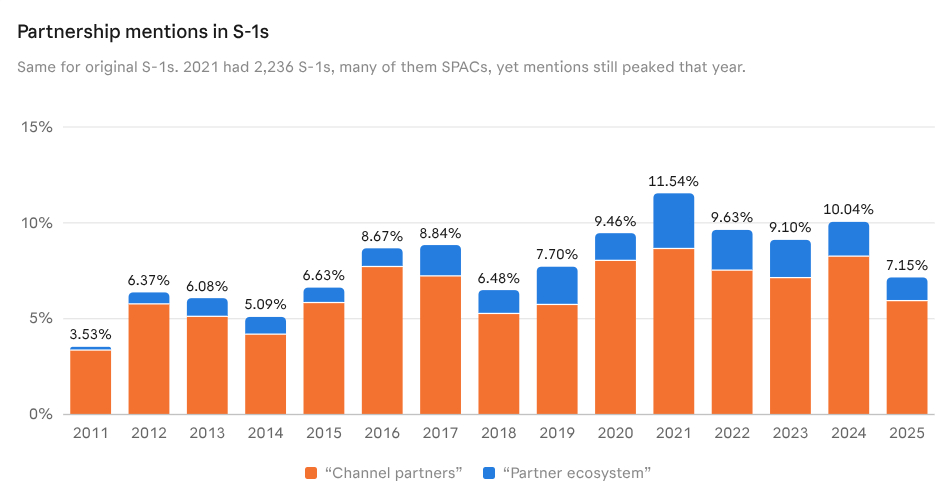
Finding: Partnership mentions in S-1s have grown steadily, from 3% in 2011 to 7% in 2025.
What the data tells us
Statistics may conceal as much as they reveal, but these different data points tell a fairly consistent story. Companies keep hiring for partnerships at a steady clip, executives bring partners up on roughly four in ten earnings calls, and the share of 10-Ks and S-1s that mention partner ecosystems or channel partners has roughly doubled since 2011. None of these metrics is perfect on its own, but together they point in the same direction: partnerships are integral to how modern technology companies succeed and grow.
When to use these metrics
Data is a tool. And like any tool, it is important to know when to use them.
Focus first on your own company’s metrics. If your company has its own partner metrics (e.g. partner-sourced revenue, partner-influenced revenue) focus there. Those metrics will carry more weight with your leadership and Board than industry-wide data.
Use industry metrics if you’re building the case from scratch. If you’re a team of one, a pioneer trying to build support for partnerships within your company, industry metrics like those above can help. Even better, rerun this analysis on a cohort of companies in your industry using the guidance below I’ve provided below.
How to pull this data for your own purposes:
Pick your cohort. Pick a list of at least 20 public companies in your sector.
Earnings calls: use a transcript database, I used EarningsCalls.dev. Fetch each company’s earnings calls, count your partner terms in code, and compare the share of calls that mention them over time.
Hiring: use a job postings database (I used Coresignal’s search, which returns counts for free). Count postings with “partnerships” in the title each month, and divide by a comparable role family like sales, so changes in the database’s coverage don’t distort the trend.
SEC filings: search 10-Ks and S-1s on EDGAR. You can use EDGAR’s MCP and connect with you your AI tool of choice.
Normalize everything. Use shares and rates, not raw counts: per 100 calls, per 100 sales postings, share of filings.