The sales team reports to the CRO. Marketing to the CMO. Operations to the COO.
But who should partnerships report to?
This is one of the most hotly-debated questions among ecosystem leaders in tech. Why? Because incentives drive outcomes. And different teams are driven by wildly different incentives.
The truth is, partnerships is the platypus of the corporate kingdom.
It has a duck bill (it looks like Sales), a beaver tail (a builder mindset, like Product) and it lays eggs (makes long-term strategic bets).
If you cage it with the birds in the Product, it can’t fly.
If you toss it into the lion’s den with Sales, it can get mauled by quarterly quotas.
Where you place this corporate platypus impacts your company’s most strategic goals.
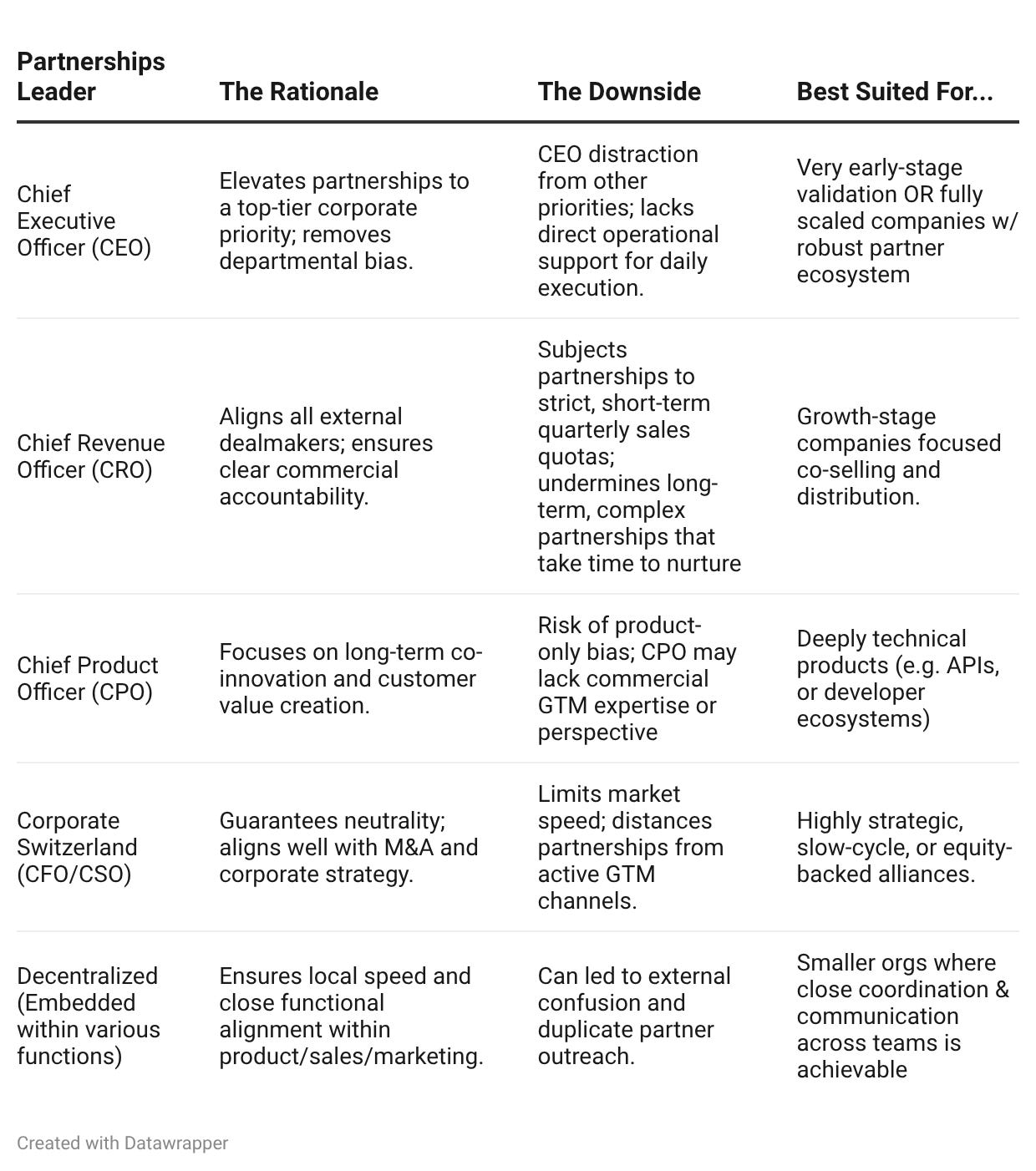
To help you navigate this dilemma, here are the cases for and against the five most common reporting structures for partnerships. I’ve also included below some perspectives from experts on the frontlines:
Partnerships Leader - Options & Trade-offs
Perspectives from the frontlines
I asked some sharp minds in tech ecosystems where they stand on this debate. Here is what they told me (off-the-record):
“CRO is the most common person for Partnership report into. But it requires a CRO who can balance quarterly targets with partner deals that take multiple quarters to close. Inexperienced sales leaders lack that strategic mindset.”
“My view is that it matters less whether it is the CRO or CMO or CFO overseeing partnerships and more what kind of a leader that person is. Do they understand how a partner ecosystem can transform a company?” Do they have trust and influence with the C-Suite and the board?
“Chief Partnerships Officer is just a title. I know Director and VP of Partnerships who have more alignment and support from their CEO.”
“I’ve seen the decentralized model work well, where Marketing and Product and Sales have their own partnerships lead or a small squad. But it requires really close coordination among those teams. It’s a terrible mess if they are not communicating.”
“Our Partnerships team was incubated within our Corp Dev team. Then we moved to Sales and then to Product. The most important thing is having a leader who truly understands and can articulate the strategic value of partnerships and advocate up to leadership and across the team through those org changes.”
Key considerations
Org structure is a journey not a destination - Don't fall for dogmatic advice that partnerships "must" report to a specific C-suite seat. Your org structure should reflect your company's current scale, product maturity, and corporate strategy. Those will change.
A marriage is more than a wedding - Signing a partnership agreement is just the start. The actual partnership is the daily grind of joint pipeline reviews, API integrations, QBRs. It is essential that the partnerships team is setup to support partners end-to-end. If you aren’t staffed to support the marriage, don't throw the wedding.
Be the Chief Translation Officer. Partnerships is still a misunderstood black box to many in finance, legal, and operations. Your team’s primary job is to constantly educate your internal stakeholders on how your partner ecosystem accelerates their specific goals.
Culture flows downhill - Ultimately, the partnership team’s success is tied directly to the team’s leader and that person’s relationship with the CEO and the rest of the C-Suite.